
Construction Jobs in Kenya
Kenya’s construction industry plays a vital role in developing infrastructure, residential housing, and commercial spaces. The construction sector provides jobs for skilled and unskilled workers involved in various building projects. It is imperative to note the various career paths in the construction sector, ranging from general site laborers to highly specialized professionals, such as quantity surveyors. At Kapstone Works Africa Limited, we provide affordable, reliable, and professional building services in Kenya, ensuring each project is constructed with efficiency and quality. We help job seekers identify their career paths and know where to connect with construction opportunities to succeed in the industry. In this article, we have discussed how and where to find construction jobs, the most common roles, the average payment ranges, training and skills required, and challenges in getting construction jobs in Kenya.

How to Get Construction Jobs in Kenya?
1. Recruitment Agencies
Recruitment agencies are among Kenya’s most common methods of acquiring construction jobs. These recruitment agencies focus on connecting contractors to professional project managers, skilled labourers, and engineers. Enrolling in recruitment agencies gives one a better opportunity to be hired for major government or privately funded projects.
2. Online Job Portals
Fuzu, Brighter Monday, and MyJobMag are some of the sites that promote openings in construction, informal jobs, and top consulting. Through online job sites, candidates can create profiles, upload their resumes, and apply directly to the employer, thus making the process transparent and smooth. The online platforms offer different career resources, including salary insights, interview tips, and networking opportunities to improve employability.
3. Networking
Connections in the local communities are also crucial in identifying opportunities. Most contractors hire workers through word-of-mouth recommendations, especially for masonry, plumbing, and electrical work. As long as one continues to maintain a social network in the industry and a reputation for reliability and skill, they will find work.
Where to Get Construction Jobs in Kenya?
- In Kenya, construction jobs are found mainly in metropolitan areas where emphasis is placed on infrastructure development. Nairobi is a city with the most significant projects, from buildings to highways and housing estates. Demand for skilled and unskilled labour is always high with the increasing developments, such as expressways and residential apartments.
- Another job opportunity hotspot is Mombasa, due to the port expansion projects and industrial activities. The road construction and manufacturing of warehouses and hotels employ hundreds of workers. Kisumu, Nakuru, and Eldoret cities are emerging construction hubs, mainly due to government-sponsored housing and road projects intended to enhance regional connectivity.
- At least half of the opportunities exist in rural areas, further away from the urban centres. On numerous occasions, county governments employ people to upgrade roads, water projects, and schools. The pay may be less than in the city projects, but these jobs at least give some form of stability in locations with very few employment options.
Commonly Available Construction Jobs in Kenya
1. General Labour
Construction jobs in Kenya are all-encompassing, taking in professionals and casual labourers. General labour is among the most common construction jobs, involving lifting, mixing cement, or cleaning construction sites. Although a general labourer is an entry-level position, it forms the foundation of most projects.
2. Masons, Electricians, and Plumbers
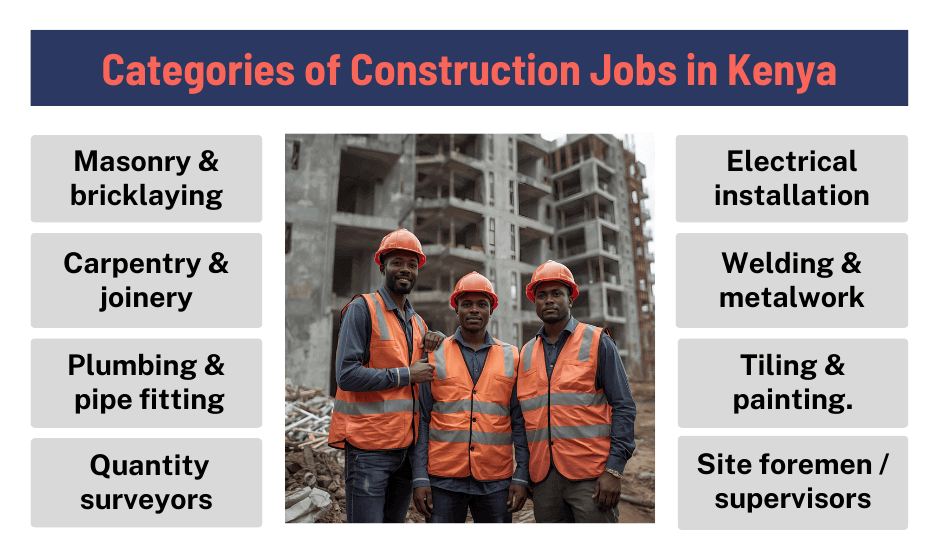
Masons who are currently in demand specialise in stonework, laying bricks, and plastering, which are crucial for commercial and residential projects. Electricians and plumbers perform essential installations that enable the buildings to be safe and functional. Electricians install and maintain the electrical systems, while plumbers install and maintain the water systems. One usually needs vocational training or certification for masonry, electrical, and plumbing jobs.
3. Civil Engineers, Project Managers, and Architects
Professionals involved in construction include civil engineers, project managers, and architects. Engineers design and supervise buildings, architects handle aesthetics and planning, and project managers coordinate the teams, tasks, and budgets. Quantity surveyors perform cost estimation, resource allocation tasks, or prepare bills of quantities. These professions require advanced education and licensure and are typically high-paying.
Construction Jobs Pay Range in Kenya
1. Casual Workers
In Kenya’s construction industry, workers are paid different salaries based on training, location, and employer. Usually, casual workers earn from 80 shillings per hour. However, such wages vary in accordance with the size and urgency of a project, with some contractors charging a premium for overtime or exceptional work.
2. Masons, Plumbers, and Electricians
Masons, plumbers, and electricians earn slightly higher wages daily, ranging from KSh 492 to KSh 1012, depending on experience and complexity of work. Depending on the task and its size, the demand of a trade, or the craftsman provided, a certified artisan could command a considerable sum. The same can be said for government projects with high standards for quality.
3 . Civil Engineers, Architects, and Project Managers
Civil engineers, architects, and project managers get salaries ranging from KSh 20,000 to KSh 300,000 per month. People who work for big companies or contractors get paid more than those who work on a small local project. As professionals, civil engineers, architects, and project managers also benefit from health insurance coverage, bonuses, and allowances, which further improve their total compensation packages.
Training and Skills for Construction Jobs in Kenya
- Training is key in the construction field in Kenya. TVET institutions run programs such as masonry, plumbing, carpentry, and electrical work, among others. We help aspiring construction workers in Kenya gain industry connections, practical training, and Construction Professional (PMI-CP) certifications that enhance their employability.
- Professional jobs require formal education; civil engineers, architects, and surveyors must be university graduates registered with professional bodies. Continuous professional development and board certification boost employability by opening higher-level opportunities, showcasing current skills, and strengthening credibility with employers. Construction professionals build structures that conform to global best practices, safety standards, and guidelines requirements through the acquired skills and knowledge.
- Soft skills such as teamwork, reliability, and time management are also essential for achieving success on the job. Employers prefer workers with additional technical skills, along with reliability and strong communication abilities, especially for large-scale projects. Such projects require working with a number of people. Interpersonal skills help candidates stand out in the job market.
Difficulties in Acquiring Construction Jobs in Kenya
- There is a high competition, particularly in urban areas where there are more job seekers than available tasks. The imbalance leads to underemployment or non-stable jobs, which are casual. Most workers are also left with the option of temporary work and lack long-term career advancements.
- When workers are hired informally, they are exposed to exploitation or not paid appropriately. If employees lack formal contracts, they may not receive their pay or be protected from danger at work. Enhancing labour laws and encouraging open recruitment are essential in ensuring workers’ rights.
- Technological improvements are also changing the workforce in the construction industry. The current machines in construction make work less manual and deprive unprofessional employees of a chance. These changes will determine one’s relevance in the industry.
Summary
In Kenya, construction jobs are available, from casual labourers to high-paying professionals. Construction jobs are available through recruitment agencies, online job portals, and networking. As the country’s infrastructure projects grow, there is a high demand for a skilled and unskilled labour force Those wishing to start a career in the construction sector must get trained, educated, network with employers, and apply for opportunities that arise in the industry. Reach out to Kapstone Works Africa Limited for guidance on where to get professional training and construction industry networks to have a seamless journey toward a successful career. You can also call us or visit our offices at Three Units Complex, First Floor, along Eastern Bypass, next to Total Service Station.