
How to Ensure the Best Construction Materials are Used in Your Project
In construction, selecting building materials is critical, as it affects compliance with codes, durability, structural stability, and resistance to environmental factors. Utilizing substandard materials can cause structural failure, accelerated deterioration of building components, and be a safety hazard for occupants, which is why it is important to carefully choose the best construction materials for your project. If you’re seeking professional construction services that prioritize sustainability, Kapstone Works Africa Limited is your trusted one-stop solution. We understand the importance of utilizing quality materials in buildings, which is why we work with trusted supply chain partners and apply building standards when choosing materials to guarantee comfort, affordability, and sustainability in every project we work on. In this article, we have highlighted common construction materials used in building projects, such as cement, sand, building stones, steel, clay, wood, and concrete, among others. We have also provided tips on selecting the most suitable materials for projects.

Common Construction Materials Used for Building Projects in Kenya
Construction materials refer to the substances that are used to create and finish building structures. Materials used for construction can be synthetic, natural, or composite, and are picked based on the suitability for the project, cost-efficiency, and sustainability. Each material has distinct characteristics that make it acceptable for specific applications in the building process.
1. Cement
Cement is a construction material in the form of a finely powdered mixture, comprising silicon, iron, calcium, and aluminium compounds, that hardens when combined with water. Cement is used to act as a binding agent in construction, as it has adhesive properties to hold materials such as bricks and stones together, forming durable structures. Cement is also utilized to seal fractures, stabilize soil, and for decorative purposes such as fencing, constructing patios, and driveways. The advantages of using cement for construction are that it is a cost-effective building material, versatile with numerous applications, easily accessible, fire-resistant, and has strong binding strength.
2. Sand
Sand is a granular construction material composed of mineral particles and finely divided rock. Common types of building sand include, but are not limited to, river, pit, beach, artificial sand, and quarry dust, with each having unique properties, advantages, and disadvantages that make them suitable for various construction applications. In construction projects, sand is mainly used to make concrete and mortar, finish or renovate walls when mixed with plaster, and in masonry for strength and stability. The advantages of using sand in construction are its durability and strength, cost-effectiveness, and offers great thermal insulation properties.
3. Bamboo
Bamboo has a long history of use in construction due to its high tensile strength, low weight, and sustainability. Bamboo provides a durable alternative to traditional timber, making it ideal for making foundation systems, building walls, partitions, roofs, and scaffolding. Apart from bamboo’s physical properties, it is an environmentally friendly option that helps in restraining soil erosion, lowering carbon emission rates, and, by growing rapidly in the right conditions, prevents deforestation. Selecting bamboo for construction means choosing sustainability, strength, and affordability while empowering Kenyan farmers and supporting green growth in the country.
4. Ballast
Ballast or kokoto is a vital component in the construction industry that is a mixture of ballast sand, chunks of rock, and gravel used in building projects to provide strength and stability. Ballast is categorized based on its material composition and application into various types, including synthetic, granular, concrete, and asphalt. The primary functions of ballast are to act as a coarse aggregate in concrete, form a stable base layer for roads and railway tracks, and build a stable foundation for walls and other structures, providing a solid base for subsequent construction. Using ballast in construction projects provides numerous benefits, such as producing strong concrete, which is crucial for strong structures, and versatility for application in commercial, industrial, and residential projects.
5. Building Stones
Building stones are rocks or minerals used in construction for both structural and decorative purposes, such as limestone, basalt. Marble, limestone, sandstone, quartzite, and slate, among others. When selecting building stones, construction workers should consider key factors such as toughness, texture, durability, crushing strength, porosity, workability, and cost-effectiveness. Stones have versatile uses in construction, with some of their functions including the building of foundations, perimeter walls, and bridges, flooring material, ornamental and architectural works, making fireproof structures, and manufacturing cement and iron. Building stones are widely used in construction projects in Kenya due to their durability, easy maintenance, uniqueness, and environmental benefits.
6. Clay
Clay is a natural soil material that is fine-grained and cohesive, commonly used in the construction and building industry in Kenya. Clay is widely used for multiple purposes, including making bricks, tiles, and mortar and constructing earthen walls and floors. Due to clay’s thermal insulation properties, it is an ideal choice for buildings in hot climates as it is designed to absorb heat during the day and release it at night. The advantages of using clay in construction are that it is versatile, energy-efficient, durable, sustainable, aesthetically pleasing, and cost-efficient.
7. Concrete
Concrete is a building material that comprises four primary ingredients, which are water, sand, gravel, and cement. Concrete has a wide range of applications in the construction industry, including creating partitions, retaining walls, fencing, building driveways and patios, parking lots, and street paving, among others. By using concrete for construction projects, builders can:
- Enable durable roads, bridges, and buildings, such as apartments, malls, perimeter walls, and warehouses, among others.
- Provide structural strength and stability to buildings.
- Ensure human safety through resistance to harsh environmental conditions.
- Enable economic growth through cost-efficient construction.
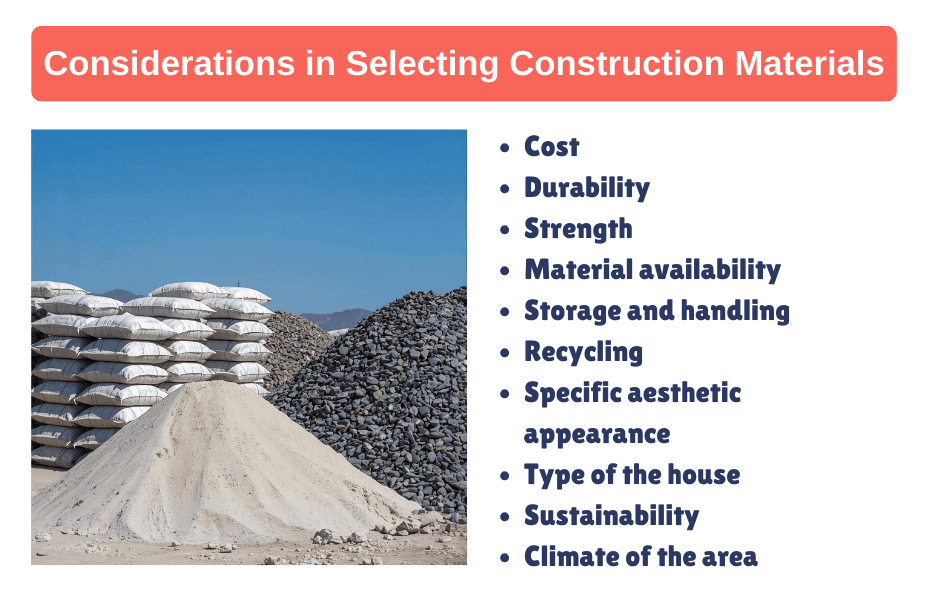
Important Tips for Selecting the Best Construction Materials for Your Building Project
- Prioritize purchasing high-quality materials that will last.
- Consider the climate of the area where the building will be constructed.
- Ensure that the building materials are readily available to avoid unnecessary transportation expenses.
- Consider utilizing green building materials to reduce the construction’s environmental impact.
- Consider environmental factors such as seismic activity, typical weather and soil conditions.
- Ensure materials selected comply with local building codes and county government regulations.
- Consider the fire-resistance rating.
Summary
Selecting the right building materials is important for the success of any construction project in Kenya. To make the right decisions, construction workers evaluate client needs, compliance with local building codes, and assess factors like strength, durability, cost-efficiency, aesthetic value, and availability, among others. In case you are looking for professional help with selecting the right construction materials for your project, your search ends here. At Kapstone Works Africa Limited, we carefully select the most suitable building supplies and provide expert assistance with construction from start to finish, ensuring durable structures. To get our professional construction services in Kenya, reach out to our expert consultants today and find out how we can help. For inquiries, please contact us or visit our offices at Three Units Complex, 1st floor, along Eastern Bypass, next to Total Service Station.